NYN Digital Desk:
A gesture meant to show respect inside a New York mosque has developed into a broader political and interfaith dispute, with Gov. Kathy Hochul defending her decision to wear a hijab while Muslim, interfaith, and community leaders condemn criticism directed at her.
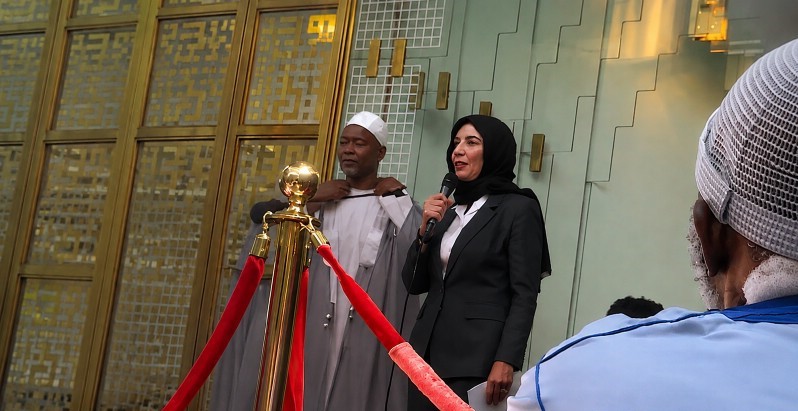
Hochul visited the Islamic Cultural Center of New York on Manhattan’s Upper East Side on a recent Friday, touring community spaces and covering her head while inside a worship area. The governor said the choice reflected the same approach she follows when entering other religious settings.
“I was invited as a guest, and I always wear the appropriate attire, whether I am going to a temple, whether I am going to an Orthodox community or whether I am going to a Catholic church in the Vatican,” Hochul said.
The visit soon drew political attacks. Nassau County Executive Bruce Blakeman, Hochul’s Republican challenger, posted an image carrying the caption, “Hijab Hochul. Kathy’s Latest Costume: Whatever the Audience Wants.” He accused her of political pandering and questioned the timing because the visit came shortly before the 25th anniversary of the Sept. 11 attacks.
Hochul rejected his criticism. “If he has problem with that, that says more about him than it does anybody else,” she said.
Blakeman later said his remarks were not directed against Muslims and noted his own visits to mosques as Nassau County executive. He also argued in comments to Newsday that Hochul’s identification as a feminist conflicted with wearing a hijab.
Hochul answered with another sharp response: “I just love it when men lecture women on whether or not they are a feminist.”
The dispute widened after President Donald Trump shared an image of Hochul wearing the head covering and accused her of seeking the “Arab Vote.” Hochul responded publicly, writing, “I was a guest in a Muslim house of worship and showed respect for the people who welcomed me. That used to be standard in this country before you came along. I’ll never apologize for treating people of any faith with dignity, no matter how Islamophobic you and your enablers are.”
Other conservative voices also attacked the visit. Commentator Graham Allen connected the appearance to the approaching Sept. 11 anniversary, while Riley Gaines criticized Hochul’s use of the hijab from a feminist perspective. The New York Young Republican Club issued its own disparaging statement about the governor’s appearance at the Islamic center.
The governor’s office noted that Hochul had worn a hijab before. Those occasions included a 2022 visit to a mosque in Ronkonkoma following an attack and the funeral of NYPD Officer Didarul Islam last year.
The backlash prompted a strong response from religious and civic leaders who argued that customary dress inside a house of worship represents courtesy rather than political endorsement.
The Interfaith Center of New York drew a comparison with customs in other religious spaces. Its statement noted that a non-Jewish visitor wearing a yarmulke in a synagogue or a woman adjusting her dress while entering a Catholic church is commonly regarded as respectful. The organization asked why Hochul’s gesture at a mosque should face a different standard.
“As New Yorkers, Americans, and people of good will, we must apply the same standards to all faith communities, and acknowledge the common dignity of all people of faith,” the organization said.
Mohammad Razvi, CEO of COPO, also defended Hochul. “Governor Hochul’s gesture of respect and solidarity sends a powerful message to Muslim New Yorkers,” Razvi said. “We deeply appreciate her recognition of our faith, traditions, and place within the diverse fabric of New York. Respect and representation build stronger communities.”
Mark Meyer Appel, founder of The Bridge MCP, said the criticism misunderstood the meaning of the governor’s action. His statement argued that honoring the customs of a synagogue, mosque, church, or other religious institution represents recognition of the people being visited, rather than preference for one religion.
“Showing courtesy by observing a house of worship’s practices should be seen as an act of respect, not a source of division,” Appel said. He urged New Yorkers to encourage public officials who engage respectfully across religious lines.
The NYC Imams Council, through Imam Muhammad Shahidullah, also issued a detailed statement supporting Hochul and rejecting criticism over the hijab.
“Wearing a hijab while visiting a mosque is a simple act of respect for the faith community being visited,” the council said. “It is no different in principle from observing the customs of a synagogue, church, temple, or any other house of worship. Respecting religious tradition is not favoritism. It is leadership.”
The council warned against turning religious courtesy into political hostility at a time of heightened concern over Islamophobia, antisemitism, religious hatred, and polarization.
“Respect for one faith is not a threat to another,” the statement concluded. “It is a foundation for a stronger, more united New York.”
Afaf Nasher, executive director of the Council on American-Islamic Relations New York, also criticized attempts to connect Hochul’s mosque visit with Sept. 11. She said Muslim New Yorkers mourn the attacks alongside other New Yorkers and Americans and rejected the suggestion that wearing a hijab represented a security or ideological statement.
Nasher also challenged the argument surrounding feminism. “The essence of equal rights is making the choice to wear a hijab or not,” she said, arguing that attacking a woman’s choice to wear one undermines the principle of personal agency.
The controversy has moved well beyond Hochul’s clothing. At its center now sits a larger question raised by several faith leaders: whether Muslim institutions and Muslim New Yorkers receive the same presumption of dignity extended to other religious communities.
Their message has remained consistent. New York belongs to people of many faiths and backgrounds. Elected officials represent all of them. Respect shown inside a mosque should be judged by the same standard as respect shown inside a church, synagogue, temple, or any other house of worship.
For more blogs, visit nyn.press