NYN Special Correspondent :
A growing Republican campaign against Sharia law in Texas has evolved into a broader dispute over the religious and civil rights of Muslim Americans, as political proposals and rhetoric increasingly touch on Islamic practices that extend far beyond questions of courts and government authority.
The controversy developed gradually through 2025 and 2026, fueled by statements from elected officials, party resolutions, legislative initiatives and disputes involving Muslim organizations across the state. What began largely as an argument over whether Islamic religious principles could influence Texas institutions has increasingly raised questions about practices such as hijab, halal food and Islamic education.
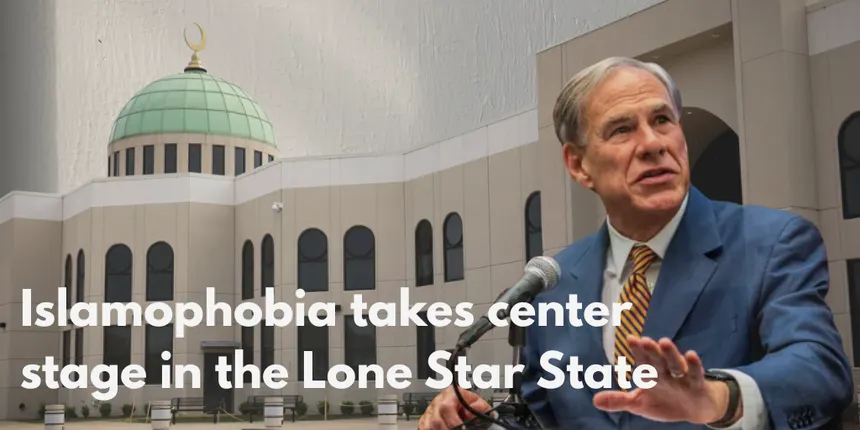
Texas Gov. Greg Abbott repeatedly argued that Texas law must remain protected from Sharia-based legal systems and took actions involving Muslim organizations and developments. The Republican Party of Texas also adopted resolutions criticizing the Council on American-Islamic Relations (CAIR).
In November 2025, Abbott issued a state proclamation designating CAIR and the Muslim Brotherhood as foreign terrorist and transnational criminal organizations. CAIR rejected the accusations. The federal government, however, has not designated CAIR itself as a foreign terrorist organization.
The political campaign intensified in March 2026, when Republican members of the Texas Legislature announced an “Anti-Sharia Caucus.” Supporters said the effort was intended to prevent Sharia from gaining influence over Texas institutions and to preserve the supremacy of state and federal constitutional law.
Muslim civil-rights organizations challenged that premise.
“Is Sharia law replacing the Texas Constitution? Absolutely not,” CAIR-Texas and CAIR Action Texas said in a March 6 fact-check. The organizations emphasized that the U.S. Constitution and the Texas Constitution remain the governing legal authorities and that no religious tradition can override them.
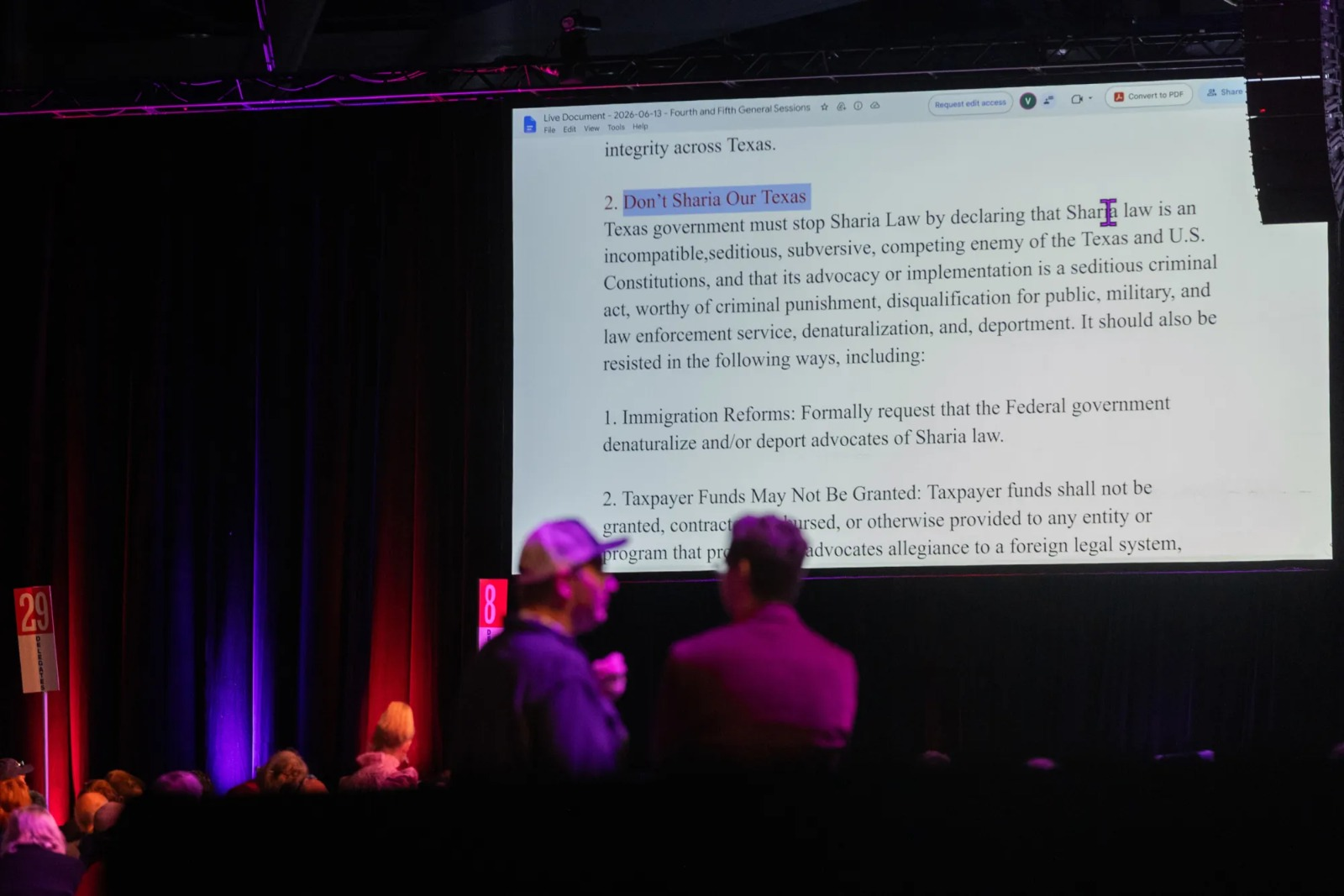
The issue later moved directly into the Republican Party of Texas’ 2026 convention process. A temporary legislative-priorities document included a proposal titled “Don’t Sharia Our Texas,” calling on the state government to take action against Sharia law and describing it as incompatible with constitutional government.
The party held its state convention in Houston in June 2026, where delegates established political priorities for the following two years. The gathering also became the setting for a highly publicized dispute involving Muslim Republicans.
According to reporting cited in the controversy, Muslim delegates encountered hostility connected to their religion and associations with CAIR. Tarek Hussein, a registered Republican delegate and founder of CAIR’s Houston chapter, attended the convention with his son. The episode became part of a broader internal debate over the place of Muslim Republicans and individuals associated with CAIR within the state party.
Since then, the controversy has moved beyond the narrow question of whether religious law could influence courts or public institutions.
Recent proposals discussed within conservative political circles have raised questions about potential restrictions involving hijab, halal food and Islamic education. That development has alarmed Muslim civil-rights advocates, who argue that Sharia has a much broader meaning for practicing Muslims than a separate governmental legal code.
For many Muslims, Sharia can encompass religious principles governing prayer, fasting, charitable giving, dietary requirements, marriage and personal conduct. Critics therefore argue that efforts framed as opposition to an alternative legal system could become constitutionally problematic if they begin restricting ordinary religious practices.
That distinction has become central to the growing political dispute.
For Muslim advocates, opposing the replacement of American law with a religious legal system is fundamentally different from restricting religious observance by individual citizens. They contend that the first principle is already protected by the existing constitutional structure, while the second could directly conflict with protections guaranteed under the First Amendment.
CAIR has emerged as one of the most prominent critics of the Texas campaign. CAIR-Texas has repeatedly argued that Muslims living in the United States are bound by the same state and federal laws as every other resident and that Islamic religious principles have no legal mechanism through which they could replace the Constitution.
In May 2026, CAIR-Texas joined several Muslim organizations in the Dallas-Fort Worth area in calling for an end to what they described as hateful rhetoric and political “fear-mongering” directed at Muslim communities.
The organization has also argued that actions and statements by public officials contribute to a broader climate in which Muslim Americans may feel increasingly targeted because of their appearance, religious practices or political associations. CAIR’s 2026 Civil Rights Report said government officials had increasingly used public office during 2025 in ways that narrowed the space for Americans to differ in appearance, speech and belief.
Republican supporters reject the characterization that their initiatives amount to an attack on Islam or Muslims.
They argue that the campaign is focused on ensuring that the U.S. Constitution, federal law and Texas law remain the sole sources of governmental authority. Supporters also say the measures are intended to guard against foreign influence, political Islamism or the emergence of any parallel legal system based on religious rules.
The Republican Party of Texas has continued to criticize CAIR and has supported Abbott’s actions involving the organization.
The dispute therefore increasingly centers on where the constitutional boundary should be drawn between preventing religious institutions from exercising governmental authority and protecting the ability of citizens to follow religious rules voluntarily in their personal lives.
That question carries particular significance for Muslim Americans because many of the practices now appearing in political discussions — including religious dress and dietary observance — are comparable to faith-based practices followed by members of other religious communities.
The First Amendment to the U.S. Constitution protects the free exercise of religion while prohibiting government establishment of religion. Those protections apply to Muslims as they do to Christians, Jews, Hindus, members of other faiths and Americans who practice no religion.
As the Texas debate continues, Muslim civil-rights advocates are urging elected officials to distinguish between legitimate constitutional or national-security concerns and policies that could single out an entire religious community.
For Muslims in Texas, the controversy has become more than a disagreement over Sharia law. It has become a debate over whether religious expression, dress, food, education and personal observance could become political targets under a campaign originally framed around legal sovereignty.
The issue may therefore serve as a significant test of how political movements balance concerns about religious legal systems with one of the country’s foundational constitutional principles: equal religious liberty for every faith.
For more blogs, visit nyn.press