Adrian Smith:
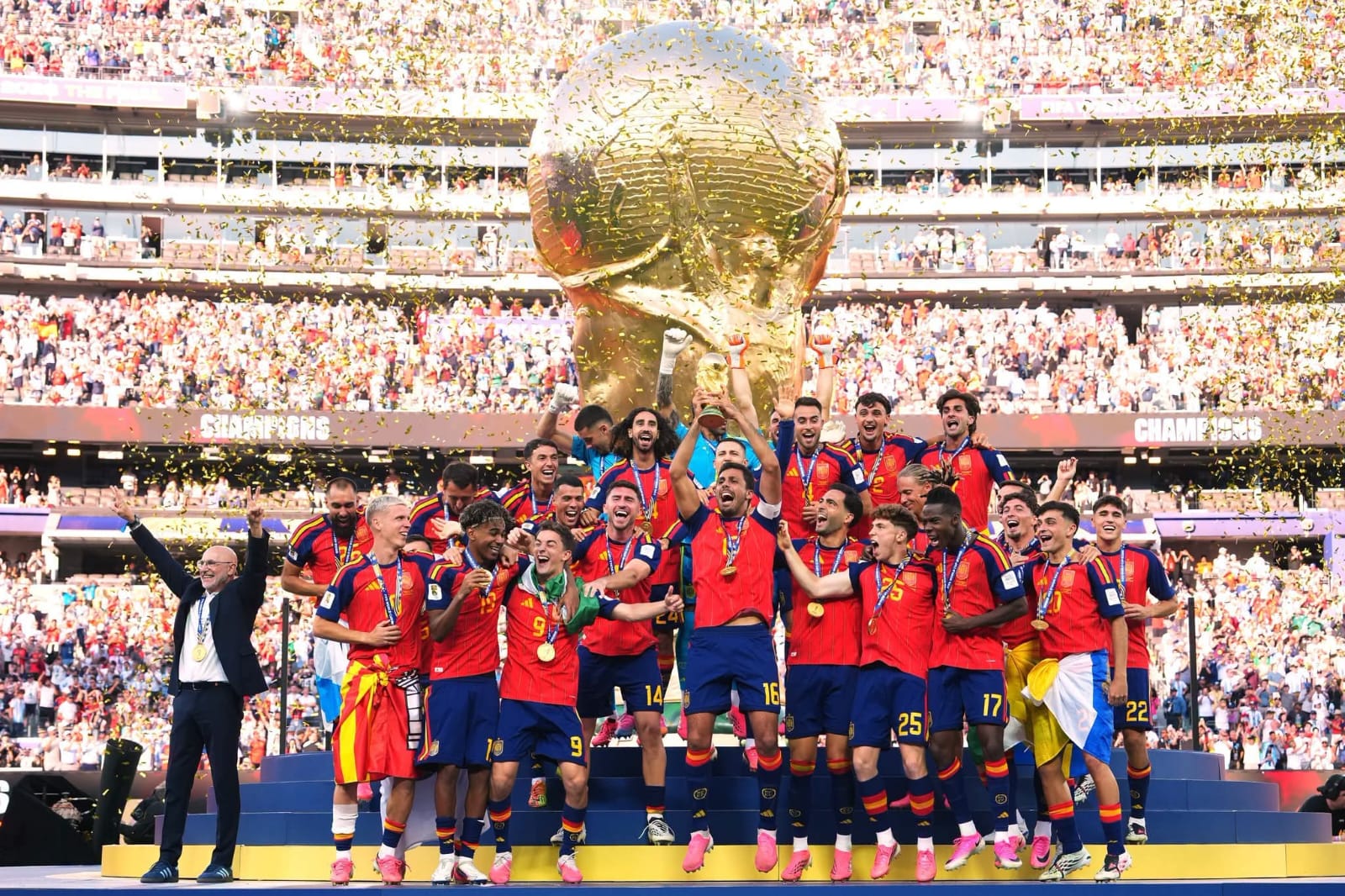
Spain returned to the summit of international soccer Sunday, defeating defending champion Argentina 1-0 in extra time to capture the 2026 FIFA World Cup and end a 16-year wait for its second men’s title.
Substitute Ferran Torres delivered the decisive moment in the 106th minute, driving a powerful shot into the top of the net beyond Argentina goalkeeper Emiliano Martínez. The goal secured Spain’s first World Cup championship since 2010, when Andrés Iniesta scored an extra-time winner against the Netherlands.
Torres became only the fifth substitute to score in a World Cup final and the first since Mario Götze won the 2014 final for Germany, also against Argentina. He also became just the second Barcelona player to score in a World Cup final, following Iniesta.
Spain controlled much of the final at New York New Jersey Stadium, dominating possession and limiting Argentina to only one shot on goal, compared with Spain’s 12. Argentina’s challenge became even more difficult when midfielder Enzo Fernández received a second yellow card, leaving the defending champions with 10 players throughout extra time.
The result likely marked the conclusion of a remarkable international era for Lionel Messi. The 39-year-old captain led Argentina to the 2022 World Cup and Copa América championships in 2021 and 2024, establishing one of the most successful periods in the country’s soccer history.
Spain’s victory completed an impressive tournament in which La Roja conceded only one goal across eight matches. After opening with a scoreless draw against Cape Verde, Spain defeated Saudi Arabia and Uruguay to win Group H. It then eliminated Austria, Portugal, Belgium and France before overcoming Argentina in the final.
Although Lamine Yamal scored only once during the tournament, the 19-year-old Barcelona winger played an important role in a balanced team that did not depend on one superstar. Mikel Oyarzabal finished with five goals, while goalkeeper Unai Simón earned the Golden Glove.
With the 2024 European Championship and the 2026 World Cup now in its possession, Spain has emerged as both the men’s and women’s world champion. The achievement has also strengthened comparisons between the current generation and the celebrated Spanish side that won three consecutive major trophies between 2008 and 2012.
For more blogs, visit nyn.press