Jessica Morgan:
Dr. Mohammed Bechari’s 2024 book examines Muslim women’s right to marital wealth through a modern lens.
It revives the Maliki concept of al-Kadd wa al-Sa‘aya as a legal and social framework for women’s economic justice.
Based on classical jurisprudence, especially Ibn ‘Ardhoun’s fatwa, the book focuses on rural and agrarian contexts.
Praised by scholars like Dr. Abdullah Mabrouk Al-Najjar for linking Islamic law with modern social justice.
Recognized as a key resource for lawmakers and legal experts on women’s rights in Muslim societies.
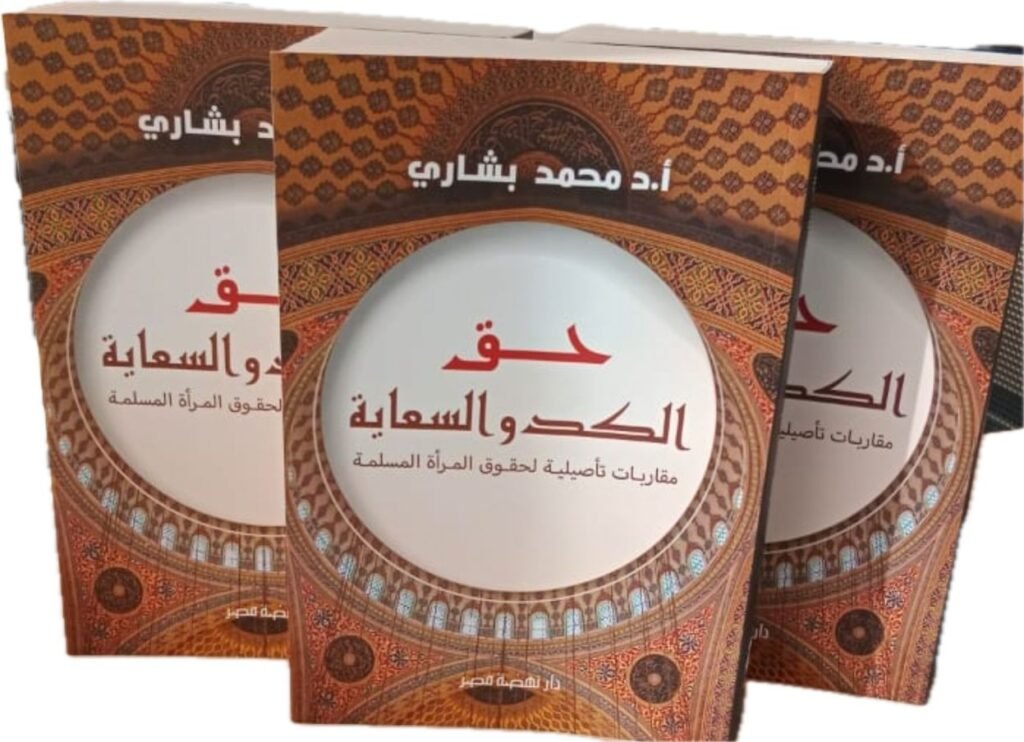
A compelling new voice has entered the debate on Islamic law and women’s rights with the publication of The Right to Labor and Contribution: An Introduction to Establishing the Rights of Muslim Women by Dr. Mohammed Bechari (Nahdet Misr, 2024). This book stands out for its thorough research and principled argument that Sharia should fully recognize women’s economic contributions within marriage. Far from being a theoretical treatise, Bechari’s work is a call to reimagine justice at the core of the Muslim family.
Central to the book is the revival of the al-Kadd wa al-Sa‘aya doctrine—the right to labor and contribution—rooted in the Maliki school of law. Bechari traces the historical evolution of women’s financial rights in Islam, highlighting the influential fatwa of Ibn ‘Ardhoun. This legal precedent, which recognized women as partners in building family wealth, has shaped Moroccan judicial practice, especially in rural areas where women’s labor has often gone unacknowledged.
Bechari’s narrative is both scholarly and urgent. He critiques the limitations of traditional jurisprudence and addresses the social injustices still faced by many Muslim women. Through careful textual analysis and legal reasoning, he argues that the right to labor and contribution is not just a legal technicality, but a comprehensive social system. As Bechari writes, it “encompasses all general and specific cases,” allowing women to benefit from their contributions without requiring elaborate contracts.
The book’s latter sections explore practical legal mechanisms for realizing women’s economic rights. Bechari addresses common objections, lays out the jurisprudential basis for recognizing women’s labor, and offers clear guidelines for judicial implementation. He pays particular attention to the realities of rural and agrarian communities, where the al-Kadd wa al-Sa‘aya doctrine could help correct longstanding patterns of exclusion.
What distinguishes this work is Bechari’s commitment to both tradition and reform. He respects Islamic law’s foundational principles while advocating for ijtihad—the creative reinterpretation of tradition in light of contemporary realities. He argues that ongoing jurisprudential renewal is essential for Islamic law’s vitality. The book concludes with practical recommendations for lawmakers and judges, urging the codification of women’s economic rights and the formal integration of al-Kadd wa al-Sa‘aya into modern legal systems.
Scholars have received the book enthusiastically. In his foreword, Dr. Abdullah Mabrouk Al-Najjar of Al-Azhar calls it “a model of rigorous jurisprudential research” and praises its actionable framework for women’s rights. Ultimately, The Right to Labor and Contribution is more than a scholarly achievement—it is a blueprint for legal and social reform that honors the dignity and rights of women as equal partners in society.
Dr. Bechari: Jurist, Thinker, Reformer
Dr. Mohammed Bechari is one of the most prominent contemporary Islamic scholars, recognized for his leadership and vision in the field of Islamic jurisprudence and interfaith dialogue. Currently based in the United Arab Emirates, Dr. Bechari serves as the Secretary-General of the World Muslim Communities Council, a position that places him at the center of global discussions on Muslim identity, integration, and rights.
Holding a PhD in Islamic jurisprudence and its principles, Dr. Bechari’s career spans top roles in both Islamic and international institutions. He has been the President of the General Federation of Muslims in France and the Council of European Muslims, and served as Dean of the Ibn Sina Institute for Humanities in France. His influence extends beyond academia into policy and community engagement, with regular contributions to leading regional and international media.
Dr. Bechari’s scholarship is marked by a commitment to bridging tradition and modernity. His previous works, including The Question of Tolerance: An Introduction to a Human Civilization System, The Interplay between Philosophy and Ethics, and Trends in the International System in the Post-Covid World (2023), reflect his wide-ranging interests in Islamic thought, ethics, and contemporary global challenges. He has received numerous honors, such as the King Abdullah II ibn Al Hussein Medal of Excellence and the Order of Arts and Sciences of the Arab Republic of Egypt, in recognition of his contributions to Islamic scholarship and intercultural understanding.
A leading voice in research on Muslim integration in Europe and the intellectual evolution of Islamic movements, Dr. Bechari is widely regarded as a scholar who combines intellectual rigor with a deep sense of social responsibility. His latest book, The Right to Labor and Contribution, cements his reputation as a reformer committed to justice, equity, and the advancement of women’s rights within the framework of Islamic law.

Publication and Reception:
The Right to Labor and Contribution: An Introduction to Establishing the Rights of Muslim Women was published by Nahdet Misr Publishing House in 2024 and quickly garnered attention in both academic and legal circles across the Arab world. The book’s release was marked by a series of launch events and panel discussions, notably in Cairo and the United Arab Emirates, where Dr. Bechari engaged with scholars, legal experts, and women’s rights advocates.
Early reviews in regional press and specialized legal forums have highlighted the book’s methodological rigor and its timely intervention in ongoing debates about the economic rights of women in Islam. Scholars from Al-Azhar University and the Moroccan judiciary have praised the work for its clarity, depth, and practical recommendations, noting its potential to influence both legislative reform and judicial practice.
Public reception has also been strong among women’s organizations and advocacy groups, who see the book as a vital resource in the struggle for legal recognition of women’s labor, particularly in rural and agrarian contexts. The book’s arguments have been cited in recent policy discussions in Morocco, where the al-Kadd wa al-Sa‘aya doctrine is increasingly referenced in family law cases.
While the book has yet to be widely reviewed in Western media, its impact within the Arabic-speaking world is clear. It is already being used as a reference in workshops and training sessions for judges and legal practitioners, and is expected to inform future reforms in personal status law across several Muslim-majority countries.
For more blogs, visit nyn.press